Showing posts with label bizonal. Show all posts
Friday, 24 August 2012
Thursday, 15 September 2011
Reconciliation and Reunification: exploration of difficulties
South Africa is an excellent point of reference for us in Cyprus who struggle both for Reconciliation and Reunification of our country's two main communities. Exploration and awareness of the difficulties involved in this, and also the path to successful solutions, are often
blocked by the interests and forces of local and global State and Capital who act to bury them under political party slogans, misdirection, and political manipulation.
We are especially in tune with the saga of the South African liberation movement for many reasons. But one in particular has become even more relevant for us in the recent decade, in that the imperialist powers and our local politicians are working to impose a racist Bizonal Apartheid regime on us (a new version of the Annan plan), just like the one that tormented South Africa until 17 years ago. Same as the apartheid regime that continues to torment the people of Palestine who live under zionist Israeli domination.
The process of Reconciliation and Reunification is very difficult, both before and after any solution - even if the solution is functional.
In South Africa, as the article below shows, even after a formal dissolution of the regime problems remain because unofficial Apartheid and the objective domination of one race over another never ended, and this generates racial hatred that is a bitter part of the social justice movement.
In Cyprus we are in an even worse position: because we have not even managed to get the occupation army to allow our people to Reunite and attempt to live together again in the same neighborhoods, workplaces and schools, as we used to in the past.
Reunification is the direction in which every person with a conscience wants us to move in. But the obstacles are tremendous. Military, economic and political obstacles are of course the most difficult, and any effort to examine the effect of social consciousness, psychology, feelings, etc. must take a secondary place.
Nevertheless, emotional and psychological factors are generated by the military, economic and political obstacles, which then take a life of their own.
Occupation, genocide and social injustice breed hatred. Hatred fuels the liberation struggle but it also makes Reconciliation and Reunification more difficult. It's a terrible cycle but it's a part of the truth, and we need to find ways to deal with it.
At the same time we need to recognize that hatred will only be gone when both the formal and the informal (de facto) structures of domination, occupation, ethnic cleansing and genocide are removed.
If our two communities succeed in removing them together, by joined action, then the dissipation of hatred will occur at the quickest rate possible, and it will gone forever. I look forward to that beautiful day.
Petros Evdokas, petros@cyprus-org.net
~~~~~~~~~~~~~~~
SAfrica rules against youth leader for hate speech
http://news.yahoo.com/safrica-rules-against-youth-leader-hate-speech-094521756.html
By DONNA BRYSON - Associated Press, Sep. 12 2011
JOHANNESBURG (AP) — The black man who leads the youth wing of South Africa's governing party has no right to sing a song some whites find offensive, a judge said Monday. Judge Collin Lamont went further than AfriForum, the white rights group that brought the hate speech suit, had demanded by saying that all South Africans, not only Julius Malema, should refrain from singing "Shoot the Boer."
Under the ruling, criminal cases can now be brought against those who sing the song or quote its lyrics. In a ruling broadcast live on national television, the judge said that while such anthems had their place during apartheid, they constitute hate speech in a society now struggling to redefine relations between the races.
Monday's ruling comes four months after hearings in Malema's hate speech trial that were broadcast live on national television. The court case is separate from Malema's ongoing African National Congress disciplinary hearings, which also have drawn wide attention.
While Monday's judgment could be seen as a setback for the embattled Malema, the lightning-rod figure might use it to rally support from South Africans who see "Shoot the Boer" as part of the heritage of the anti-apartheid movement. "Boer" means farmer in the language of South Africa's Dutch descendants known as Afrikaners, and is broadly used to refer to whites in general and Afrikaners in particular.
In a statement, the ANC said it was "appalled" by the decision, but would respect it while deciding what steps to take next. Malema, who was not in court Monday but testified at length during hearings earlier this year, had argued the song was not a literal threat against whites.
Malema and the ANC said it was a symbolic call to fight oppression, both under apartheid and 17 years after the end of white rule in a society where the black majority largely remains poor. After the ruling, crowds outside the downtown Johannesburg courtroom sang the song in defiance of the judge.
ANC Youth League leaders urged them to respect the ruling while they consulted with their lawyers about whether to appeal or take other steps. Malema, 30, has forced South Africa to confront its racial divide, insisted on trying to set his party's political and economic agenda, and claimed to represent the country's restive, poor, black majority.
The disciplinary hearings, which could lead to Malema's suspension or expulsion from the party, focus on accusations he is undermining President Jacob Zuma.
The ANC leaders who make government policy have consistently — and at times mockingly — rejected Malema's calls to nationalize mining or confiscate property from whites to hand over to blacks.
But he cannot be ignored. The vehemence and volume of his rhetoric could, over time, be influential. And his Youth League's reputation for getting voters to the polls means it has influence when the party draws up candidate lists.
Malema took credit for putting Zuma at the top of the ANC list in 2009, though he now accuses the president of being too moderate. The next election is in 2014, but the ANC could replace Zuma before that in a process akin to a vote of confidence within the party.
Malema was raised by a single mother who worked as a maid in one of South Africa's most impoverished regions. He shares those biographical details with Zuma, and they explain some of his appeal among poorer South Africans. His appeal has not been undermined by his recent acquisitions of expensive cars, flamboyant friends and a home in one of Johannesburg's most expensive neighborhoods.
Critics question whether he's sold political favors to get his wealth, charges he denies even as police and an anti-corruption office investigate. Critics also say he sets an example that feeds materialistic aspirations among young South Africans that their elders fear have crowded out the previous generation's goals of replacing apartheid with a just and humane society.
In the hate speech case, AfriForum chief executive Kallie Kriel said at court Monday his group respected the heritage of the anti-apartheid movement, but agreed with Lamont that South Africa now should move on.
"We need to find mutual recognition and respect among communities," he said, calling the ruling a victory over Malema's vision of South Africa. Leslie Mkhabela, Malema's lawyer, said he did not believe courts were the right forum to debate such social issues.
The judge had made a point similar to Mkhabela's during the trial, urging the parties to find a mediated settlement. Monday, he said he hoped the attention the trial had drawn, and his decision to allow much of it to be broadcast, would help South Africans heal by learning about each other after decades of being separated by the violence and injustice of apartheid.
Lamont spoke for nearly two hours before delivering his ruling, touching on South Africa's colonial history, the struggle against apartheid and the media attention and public outrage Malema had drawn with his insistence on singing such lyrics as "shoot the boer, they are rapists, robbers."
Lamont also spoke of the limitations of the law, acknowledging that while he could issue an order banning a song, many South Africans "are passionate about the right to sing the song." He urged South Africans to "pursue new ideals and find a new morality. They must develop new customs and rejoice in developing society by giving up old practices which are hurtful to members who live in that society with them."
___ Donna Bryson can be reached on http://twitter.com/dbrysonA
~~~~~~~~~~~~~~~~~~~
An earlier version of this article can be found at the Turko-Hellenic Friendship and Dialogue group named KaliMerhaba:
http://groups.yahoo.com/group/kalimerhaba_HellenoTurkish_Community/message/2612
Images The photo of the mangled Hellenic statue is from the occupied ancient city Salamis, where illegal excavations and commercial exploration are part of an ethnic cleansing process that continues to this day, throughout almost 40 years of occupation.
Republished from here:
http://www.parathyro.com/?p=4028
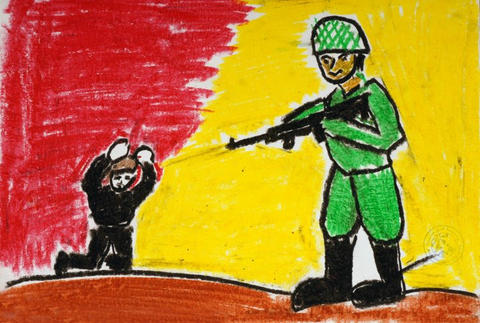
Childrens' paintings of occupation, division and war atrocities against civilians are from an article published in the Electronic Intifada, titled:
Gaza children’s images of war censored under pressure from US Israel lobby
http://electronicintifada.net/content/gaza-childrens-images-war-censored-under-pressure-us-israel-lobby/10373
~~~~~~~~~~~~~~~~~~~~
Labels:
apartheid,
bizonal,
english,
liberation,
occupation,
Palestine,
Petros Evdokas,
South Africa
Friday, 17 December 2010
Avrupa Sol Partisi’nin Kıbrısla ilgili kararı


YKP’nin de gözlemci üyesi olduğu Avrupa Sol Partisi’nin 3. Kongresi (ASP) 3-5 Aralık’ta Paris’te, La Defense’taki CNIT’da yapılmış ve YKP Yürütme Kurulu üyeleri Murat Kanatlı ve Nevzat Hami ile YKPfem aktivisti ve YKP Parti Meclisi üyesi Faika Deniz Paşa YKP adına kongreye katılmıştı…
Krize ve neo liberal politikalara karşı Sosyal Avrupa Ajandası başlıklı kongre dokümanın karara bağlandığı 5 Aralık’taki son günde ayrıca Kongre kararları da görüşülerek onaylanmıştı. Ajandada Kıbrıs konusundaki bölümde “Adanın işgalini tamamlamaya yönelik politik bir eylemi olan Türkiye’den Kıbrıs’a nüfus transferi hemen durdurulmalı. Kıbrıs Cumhuriyeti’nin yüzde 37’sini işgal etmiş Türkiye işgali son erdirilmelidir. Türkiye hükümeti Kıbrıs sorununun, Avrupa hukukuna, devletler hukuku ve BM kararlarına uygun, adaletli ve uygulanabilir çözümü için devam eden görüşme sürecine daha fazla pratik katkı yapmalıdır. Kıbrıs’taki tüm taraflar ilgili BM kararları çerçevesinde iki bölgeli, iki toplumlu birleşik bir Kıbrıs için daha faza katkı yapmalıdır” ifadelerine yer verilmişti…5 Aralık’ta onaylanan Kıbrıs’la ilgili kararın çevirisi şöyle:
Avrupa Sol Partisi
3. Kongresi – Paris 3-5 Aralık 2010
Kıbrıs’ın yeniden birleştirilmesi için mücadele ve Ortadoğu ile Avrupa’da barış ve güvenlik
Kıbrıs Cumhuriyeti toprağının %37’sinin Türkiye tarafından işgal edilmesini, Türkiye’den planlı bir şekilde nüfus yerleştirilmesini, kültürel mirasın tahrip edilmesini ve 1974’ten bu yana Cumhuriyet’in kontrolu altında bulunmayan bölgelerde toprak ve mal gaspını kınamaktayız.
İnanıyoruz ki, Kıbrıs sorununa barışçı, adil, karşılıklı olarak kabul edilir ve yaşayabilir bir çözüm bulunmasının uygun yolu, BM Güvenlik Konseyi kararları, 1977-79 doruk anlaşmaları, uluslararası hukuk ve aynı zamanda, Avrupa’nın kuruluş değerleri ve ilkeleri temelinde, BM gözetiminde özlü ve doğrudan görüşmelerdir.
BM gözetimi altında görüşmelerin canlandırılmasını memnuniyetle karşılarız. Kapsamlı bir çözüm için yapıcı bir şekilde birlikte çalışmaları konusunda iki lideri teşvik ederiz. bir çözüme varılması için Cumhurbaşkanı Hristofiyas’ın gösterdiği sürekli çabalarına bir kez daha destek belirtiriz. Yakın geçmişin olumsuz deneyimini göz önünde bulundurarak, boğucu takvimlerden ve hakemli arabuluculuktan kaçınılmalı ve sürece Kıbrıslılar sahip olmaya devam etmelidir.
İnanıyoruz ki, tüm çabalar, mümkün olan erken bir zamanda bir çözüme ulaşılması üzerinde yoğunlaşmalıdır. Bu, Türk ve Kıbrıs Türk tarafının, masada makul bir uzlaşmaya hazır olduğunu pratikte göstermesi halinde ve böylece, görüşmeler sürecinin başlamasından önce iki lider tarafından belirlenen çerçeve anlaşması içerisinde kalarak başarılabilinir.
Kıbrıs sorununun çözümünün, Kıbrıs Cumhuriyetinin toprak bütünlüğü, tek egemenliği, uluslararası tek kimliği ve tek yurttaşlığı, BM Güvenlik Konseyi’nin ilgili kararlarında öngörüldüğü gibi siyasi eşitliği olan bağımsız, iki kesimli, iki toplumlu bir federasyona dönüşmesi temelinde olması gerektiğinin altını çizeriz. Çözüm, Türk işgal kuvvetlerinin çekilmesini, işgalin kaldırılmasını ve yasadışı yerleşimci akışının durdurulmasını sağlamalıdır. Kıbrıs sorununun çözümü, tüm göçmenlerin evlerine ve mülklerine dönme hakkı ve her iki toplumdan da kayıp kişilerin ailelerinin, sevdiklerinin akıbetleri konusunda bilgilendirilmeleri hakkı dahil, tüm yurttaşların insan haklarını ve temel özgürlüklerini uluslararası hukuk ve BM anayasası uyarınca güvence altına almalıdır.
Kıbrıs’ın kuzey kesiminde nüfus yapısının değiştirilmesi bir mühendislik sürecidir. Bu, Türkiye Cumhuriyeti devleti ve sivil yönetiminin, adanın kuzey kesiminin fethi ve Türkiyeleştirme sürecini tamamlaması için siyasi bir eylemidir.
Cenevre Konvansiyonuna göre işgal altındaki bölgelere nüfus aktarılması bir savaş suçudur...
Türkiye üzerindeki etkisini kullanarak, onu Kıbrıs konusundaki sürdürdüğü politikasını terk etmesini; Lefkoşa, Dillirga ve Mesarga bölgesi, Maronit köyleri ve Mağusa’nın askersizleştirilmesini kabul dilmesini ve güven artırıcı bir önlem olarak mülklerine dönebilmeleri için Maraş’ın yasal sahiplerine verilmesini; Yabancı orduların adadan ayrılması konusunda bir gündem hazırlayarak bu çerçevede en azından on bin askerin şimdiden çekilmesine olanak sağlamak ve geriye kalanların da çekilmesi yönünde çalışma yapmak ve yukarıda anlatıldığı biçimiyle Kıbrıs sorununa adil ve yaşayabilir bir çözüm bulunmasına yardımcı olacak yapıcı bir tavır içine girmesini teşvik etmeleri yönünde uluslararası topluluğa çağırıda bulunuruz.
Kıbrıs Türk toplumu da Avrupa ailesinin bir parçasıdır ve Avrupalı tüm diğer işçiler gibi Avrupa hukukundan, direktiflerinden ve Konvansiyonlarından eşit bir şekilde yararlanma hakkına sahiptir...
Avrupalı Sol Partisi, yukarıda anlatıldığı düşünceler doğrultusunda Kıbrıs sorununa bir çözüm bulunması için aktif destek sağlamaya devam edecektir, çünkü Kıbrıs sorununun çözümü Doğu Akdeniz bölgesindeki barışa önemli bir katkı olacak ve yabancı askeri üslerin olmadığı askersiz bir Kıbrıs, Avrupa, Ortadoğu ve Afrika arasında bir barış ve işbirliği köprüsü olacaktır.
OrjinaliEuropean Left
3rd Congress – Paris 3-5 December 2010
Cyprus, the struggle for the re-unification of island and peace and security in the Middle East and Europe
We condemn the occupation of 37% of the territory of the Republic of Cyprus by Turkey, the organized settlement from mainland Turkey, the destruction of cultural heritage and the usurpation of land and properties in the areas not under the control of the Republic since 1974. We believe that the appropriate way to reach a peaceful, just, mutually acceptable and viable solution of the Cyprus problem is through substantive and direct negotiations under the auspices of the UN, on the basis of the UN Security Council Resolutions, the High-Level Agreements of 1977 and 1979, International Law as well as the values and fundamental principles on which the EU is founded.
We welcome the revival of the negotiations under UN auspices. We urge the leaders of the two communities to work together in a constructive manner for a comprehensive settlement. We reiterate our support for the consistent efforts of President Christophias to achieve an agreed solution. Taking into account the negative experience of the recent past, suffocating timetables and arbitration should be avoided and the procedure should remain of Cypriot ownership.
We believe that all efforts should be concentrated on reaching a solution as soon as possible. This can be achieved only if the Turkish and Turkish Cypriot side will show in practice their readiness for a decent compromise at the negotiation table, thus remaining in the agreed framework of the solution as defined by the two leaders before the commencement of the negotiation procedure.
We underline that the settlement of the Cyprus problem must be based on the evolution of the Republic of Cyprus into an independent, bi-zonal, bi-communal federation with territorial integrity, a single sovereignty, single international personality single citizenship, political equality as provided by the relevant Security Council Resolutions. The solution must provide for the withdrawal of Turkish occupation troops the lifting of the occupation and the termination of the illegal influx of settlers. The solution of the Cyprus problem should safeguard human rights and fundamental freedoms for all citizens, in line with international law and the UN Charter, including the right of refugees to return to their homes and properties and the right of the families of missing persons in both Communities to be informed of the fate of their loved ones.
The changing of the demographic structures in the northern part of Cyprus is an engineered process. It is a political act by the state and civilian administration of the Republic of Turkey to complete the conquering, and the Turkification of the northern part of island.
According to the Geneva Convention it is a war crime to transfer populations to occupied territories…
We call on the international community to exercise their influence on Turkey and urge it to abandon its current policy towards Cyprus, accept the demilitarization of Nicosia, Tylliria, and Mesaoria area, Maronitte Villages and Famagusta and give Varosia to its lawful owners in order to return back to their properties in this area as a Confidence Building Measure; making an agenda for withdrawal of the foreign armed forces from the island, within this framework withdrawing at least 10,000 troops now and starting the necessary work for the withdrawal of the remainder and adopt a constructive attitude that will help in the formulation of a just and viable solution to the Cyprus problem as described above.
The Turkish Cypriot Community is also part of the European family and has the right to enjoy and get equal benefit from European law, directives and conventions like all other European workers… The European Left Party, will continue to support actively the efforts for a solution to the Cyprus problem along the lines described above, as the solution of the Cyprus problem will be a significant contribution to peace in the region of the Eastern Mediterranean and a demilitarized Cyprus, without foreign military bases, will be a bridge of peace and cooperation between Europe, the Middle East and Africa.

Labels:
bizonal,
murat kanatli,
turkce,
ykp
Monday, 29 November 2010
Highlights, Pearls, Distortions, Omissions and Lies
Ban Ki-moon's Report after the New York performance
United Nations Secretary General Ban Ki-moon met with Cyprus President Demetris Christofias and Turkish Cypriot leader Dervis Eroglu on Thursday, Nov. 18, 2010 at the United Nations headquarters in New York.
Please read the Full Text of the Secretary General's Report here:
http://cyprusindymedia.org/FULL-TEXT-UNSG-REPORT.pdf
Or if you prefer to just see the highlights, please see below where we publish a collection of short excerpts from the Report. They can be helpful for understanding the orientation of Mr. Ban Ki-moon and the UN Security Council toward the possibility of Peace and Justice in Cyprus.
Following that is a short Commentary identifying some of the Distortions, Omissions and Lies embedded in the Report.
The Secretary General's Report consists of 44 numbered paragraphs. The numbers in our text follow the Report so that the origin of each quote can be found easily within the Full Text version. We have rendered some of the text in bold for emphasis.
"4.
The current round of negotiations was initiated following the agreement ...between the Greek Cypriot leader, Mr. Demetris Christofias, and the Turkish Cypriot leader, Mr. Mehmet Ali Talat.
...The two leaders reaffirmed their commitment to a bizonal, bicommunal federation with political equality, as defined by relevant Security Council resolutions. This partnership will have a Federal Government with a single international personality, as well as a Turkish Cypriot Constituent State and a Greek Cypriot Constituent State of equal status... In a joint statement, the leaders stated that they had “discussed the issues of single sovereignty and citizenship which they agreed in principle”.
A further joint statement was issued on 25 July 2008, which affirmed that: “The aim of the fullfledged negotiations is to find a mutually acceptable solution to the Cyprus problem which will safeguard the fundamental and legitimate rights and interests of Greek Cypriots and Turkish Cypriots. The agreed solution will be put to separate simultaneous referenda”.
22.
Basic differences exist between the two sides. The Greek Cypriots hold, as a matter of principle, that the Greek Cypriots with property in the north should be able to choose between exchange, compensation or reinstatement. This is unacceptable to the Turkish Cypriots who say that 70 to 80 per cent of the property in the north is owned by Greek Cypriots and if all Greek Cypriot property owners were to be allowed reinstatement it would be impossible for the Turkish Cypriots to secure bizonality. The Turkish Cypriots request a ceiling on the number of Greek Cypriots who can have their properties reinstated. For the Greek Cypriots this is unacceptable. For the time being these two positions are irreconcilable.
23.
We must be clear that to negotiate successfully a bizonal, bicommunal federation, the two leaders will have to reconcile these and other seemingly irreconcilable issues across all six chapters. These include the issue of territory, as the Greek Cypriots have made it clear that it will be impossible for them to move forward without linking property discussions to the territory chapter.
On the Treaty of Guarantee, the Turkish Cypriots and Turkey insist that the Treaty remain while the Greek Cypriots want it terminated.
29.
The process so far has been characterized by periods of sluggish activity together with some flashes on dynamism ahead of important events. It is my concern that the political environment in the second quarter of 2011 will likely not be conducive to constructive negotiations. Parliamentary elections in the south are scheduled for May, while elections will be held in Turkey in June.
32.
The near-total official secrecy of the negotiations, based on the principle of “nothing is agreed until everything is agreed”, while understandable from the practical standpoint, has also not been helpful on the public front. This tension between confidentiality and transparency has no easy solution in peace processes. Unfortunately, the only detailed information that the public has been given of the negotiations is as a result of selective leaking of texts through media. Not surprisingly, polls show the public in general would like to be better informed about what is happening in the talks and able to have more input into the process.
33.
I have been very disappointed to see a steady stream of untruthful and highly negative remarks about the United Nations reflected in the media. This criticism and misinformation about the UN is most unfortunate. Efforts by opponents of a solution to undermine the UN's credibility directly undermines the process itself.
35.
The international community has remained engaged in the Cyprus peace process due to the critical importance of its resolution for the island as well as the region and there is a clear expectation that it will succeed.
While some progress has been made, it has been frustratingly slow. When I visited the island in February, I urged the leaders of the two communities not to waste this historic opportunity. International expectations were high that the leaders of Cyprus would rise to the challenge, and that a solution was within reach. It is disappointing that, as we approach the end of the year, those expectations have not been met.
36.
Now is the moment to dedicate all efforts to bring these negotiations to a successful conclusion. Having stated their commitment to the shared goals of a bizonal, bicommunal federation, the leaders of Cyprus are expected to make good on their commitment to that outcome.
37.
Special Adviser Downer and his team have been working hard to be as helpful to this process as possible, and they have my full support. The United Nations will remain intensively engaged during this upcoming phase in the process. However, the destiny of Cyprus is largely in the hands of the leaders of both communities.
43.
The active participation and engagement of civil society in the effort to reach a solution and its implementation is also a crucial aspect of the negotiations. Now, more than ever, as public support is flagging, civil society can play an important role in supporting the leaders and the process."
In the Report, there is not a single mention of Turkey as an occupation force on the island. The words "military" and "occupation" are entirely missing. Nor is there any mention of the fact that the invasion, occupation, ethnic cleansing, genocide and continued occupation of Cyprus is made possible only through military weapons and training from the United States of America.
Also not mentioned is that the United Kingdom is a power illegally occupying a part of Cyprus with military forces.
Given the fact that the United States, as the military power enabling the occupation of Cyprus, and the United Kingdom, a military power occupying a part of Cyprus, are both Permanent Members of the UN Security Council and leading forces within it, and that Turkey, the force illegally occupying all of the north of Cyprus is also currently a member of the UN Security Council, what validity or legality is there in the "relevant Security Council resolutions" quoted by Ban Ki-moon?
The problem in Cyprus is presented in the Report as if it is a "difference of opinion" between the Turkish Cypriots and Greek Cypriot leaders, or as a conflict between the two communities, whereas in reality the two communities have no real conflicts of interest between us.
Removal of the military occupation forces is not mentioned. At all. Nor is there any recognition of the fact that any solution, no matter what its final form, is crucially dependent on the withdrawal of the occupation forces. The solution is presented as something that will supposedly come from the agreement of the two community leaders, even though the leader of the Turkish Cypriot community does not have the power to order a withdrawal of the occupation troops back to Turkey. In other words, the basic premise of the negotiations, and the Report on them, is a complete fraud.
There is no mention of the two most crucial UN Security Council Resolutions of July 1974 and August 1974 calling for "the withdrawal without delay from the Republic of Cyprus of foreign military personnel present otherwise than under the authority of international agreements":
http://cyprusindymedia.blogspot.com/2010/08/security-council-resolutions-of-20-july.html
There is no mention of the occupation regime as an illegal state, nor of the illegal status of the Turkish Cypriot representative who calls himself a "Head of State" in defiance of the resolution issued by the UN Security Council itself in 1985 condemning the separatist unilateral "declaration of independence" that was announced by the occupation regime that was illegally installed through force or arms by Turkey's military.
In the Report, the part of Cyprus that remains unoccupied and legally constituted as a State by all international laws and agreements is referred to as "the south". This is a direct insult thrown in the face of the President of the Republic of Cyprus, and a clear effort to downgrade and denigrate the Republic of Cyprus. President Christofias is either incapable of understanding this, or entirely uncaring about it. This is an injury to both the Turkish Cypriot and Greek Cypriot communities who are all legally Citizens of the Republic and, as legally recognized European Union citizens are represented in the EU and at the United Nations by the Government of the Republic of Cyprus.
There is no mention of the fact that the "Bizonal Solution" for Cyprus that is being forged by the occupation forces in concert with the global powers through the "good offices" of the UN Secretary General and with the collaboration of local politicians is a system of racist Apartheid, modelled after South Africa's Apartheid system. It is replete with Race Laws that will cover everything from the geographical distribution of the people into two Zones according to Race (ethnicity, religion, language), all the way to property rights; education; employment in civil service; electoral rights and demographic quotas.
Ban Ki-moon recognizes that there is opposition to this racist plan. Antiracist activists recognize that if the Bizonal partition of Cyprus is effected and Apartheid becomes officially instituted, this particular form of inequality and injustice will be a guarantee for eternal war in and around Cyprus. But in the Report, the racist Bizonal arrangement is presented in an idealised form, concealing its true political nature. While those who work for a solution that can guarantee lasting Peace and Justice by demanding first and foremost a withdrawal of the occupation armies, are labelled as "opponents of a solution". Is it just a clever manipulation, or deliberate maliciousness?
Throughout the Report, there are references manifesting a recognition that antiracist and anti-imperialist forces in Cyprus oppose the Bizonal plan. This is highlighted in the Secretary General's choice of words: at one point he says "Now, more than ever, as public support is flagging..."
At other points he seems to be scolding the two community leaders for not having done enough to bend and neutralize opposition to the Bizonal Apartheid plan. He tells them that the global powers - which he calls the "international community " - have expectations, he calls on the two leaders to "rise to the challenge" because "those expectations have not been met." He tells them that "the leaders of Cyprus are expected to make good on their commitment to that outcome." In other words, the demand to satisfy the global powers is more important than welfare, peace and justice for the people of Cyprus. If the people complain about the injustices built into the Bizonal Apartheid plan, it's the leaders' task to neutralize those complaints. Ban Ki-moon says that "it is incumbent on the leaders to reverse the cycle of negative messaging."
And he proceeds to tell them to not assume that "public opinion will be easily pulled along", but that they need to do certain things to achieve that. One of them is to realize that "civil society can play an important role in supporting the leaders and the process."
And what does this mean? He is suggesting more clever manipulations in order to deceive the public into accepting this racist solution. He provides the necessary elements of the choreography that will lead to public acceptance. One of them, as we saw above, is to label antiracist opponents of the Bizonal plan as "opponents of a solution". Another suggestion is that "parliamentarians and political actors on both sides should more consistently demonstrate their support for the negotiation process". And the best suggestion is to play the gender card! Here is how he phrased it - the full text of paragraph 43:
And to this idea all we can say is that it is the most disgusting inversion, perversion and degradation of Feminism.
It's bad enough that Secretary General Ban Ki-moon wants to promote a racist Bizonal form of Apartheid on our island as a "final solution" to the Cyprus problem in order to better serve the Imperialist powers who are his patrons and supporters. It's also despicable that President Christofias and Mehmet Ali Talat pretended to provide a "socialist" marketing and "leftist" packaging of the racist plan in order to make it acceptable to the people. But to sink as low as to concoct a perverted illusion of "Feminist support" for Apartheid?
Shame on you Mr. Ki-moon.
Petros Evdokas, petros@cyprus-org.net
Collective or Individual Signatures?
http://cyprusindymedia.blogspot.com/2008/10/collective-or-individual-signatures-for.html
~~~~~~~~~~~~~~~~~~~~
Is "Ki-moon" a greek word?
"Kimono, kimono, kimono. Ha! Of course! Kimono is come from the Greek word himona, is mean winter..."
http://www.imdb.com/character/ch0008970/quotes
Alexander Downer on the Global Scene
Radical and Mainstream Press: a Convergence?
http://indymedia.org.au/2010/11/06/alexander-downer-exposed-a-report-from-cyprus-indymedia
~~~~~~~~~~~~~~~~~~~
United Nations Secretary General Ban Ki-moon met with Cyprus President Demetris Christofias and Turkish Cypriot leader Dervis Eroglu on Thursday, Nov. 18, 2010 at the United Nations headquarters in New York.
Please read the Full Text of the Secretary General's Report here:http://cyprusindymedia.org/FULL-TEXT-UNSG-REPORT.pdf
Or if you prefer to just see the highlights, please see below where we publish a collection of short excerpts from the Report. They can be helpful for understanding the orientation of Mr. Ban Ki-moon and the UN Security Council toward the possibility of Peace and Justice in Cyprus.
Following that is a short Commentary identifying some of the Distortions, Omissions and Lies embedded in the Report.
The Secretary General's Report consists of 44 numbered paragraphs. The numbers in our text follow the Report so that the origin of each quote can be found easily within the Full Text version. We have rendered some of the text in bold for emphasis.
* * *
Pearls from the
Report of the Secretary-General on his mission of good offices in Cyprus
Pearls from the
Report of the Secretary-General on his mission of good offices in Cyprus
"4.
The current round of negotiations was initiated following the agreement ...between the Greek Cypriot leader, Mr. Demetris Christofias, and the Turkish Cypriot leader, Mr. Mehmet Ali Talat.
...The two leaders reaffirmed their commitment to a bizonal, bicommunal federation with political equality, as defined by relevant Security Council resolutions. This partnership will have a Federal Government with a single international personality, as well as a Turkish Cypriot Constituent State and a Greek Cypriot Constituent State of equal status... In a joint statement, the leaders stated that they had “discussed the issues of single sovereignty and citizenship which they agreed in principle”.
A further joint statement was issued on 25 July 2008, which affirmed that: “The aim of the fullfledged negotiations is to find a mutually acceptable solution to the Cyprus problem which will safeguard the fundamental and legitimate rights and interests of Greek Cypriots and Turkish Cypriots. The agreed solution will be put to separate simultaneous referenda”.
22.
Basic differences exist between the two sides. The Greek Cypriots hold, as a matter of principle, that the Greek Cypriots with property in the north should be able to choose between exchange, compensation or reinstatement. This is unacceptable to the Turkish Cypriots who say that 70 to 80 per cent of the property in the north is owned by Greek Cypriots and if all Greek Cypriot property owners were to be allowed reinstatement it would be impossible for the Turkish Cypriots to secure bizonality. The Turkish Cypriots request a ceiling on the number of Greek Cypriots who can have their properties reinstated. For the Greek Cypriots this is unacceptable. For the time being these two positions are irreconcilable.
23.
We must be clear that to negotiate successfully a bizonal, bicommunal federation, the two leaders will have to reconcile these and other seemingly irreconcilable issues across all six chapters. These include the issue of territory, as the Greek Cypriots have made it clear that it will be impossible for them to move forward without linking property discussions to the territory chapter.
On the Treaty of Guarantee, the Turkish Cypriots and Turkey insist that the Treaty remain while the Greek Cypriots want it terminated.
29.
The process so far has been characterized by periods of sluggish activity together with some flashes on dynamism ahead of important events. It is my concern that the political environment in the second quarter of 2011 will likely not be conducive to constructive negotiations. Parliamentary elections in the south are scheduled for May, while elections will be held in Turkey in June.
32.
The near-total official secrecy of the negotiations, based on the principle of “nothing is agreed until everything is agreed”, while understandable from the practical standpoint, has also not been helpful on the public front. This tension between confidentiality and transparency has no easy solution in peace processes. Unfortunately, the only detailed information that the public has been given of the negotiations is as a result of selective leaking of texts through media. Not surprisingly, polls show the public in general would like to be better informed about what is happening in the talks and able to have more input into the process.
33.
I have been very disappointed to see a steady stream of untruthful and highly negative remarks about the United Nations reflected in the media. This criticism and misinformation about the UN is most unfortunate. Efforts by opponents of a solution to undermine the UN's credibility directly undermines the process itself.
35.
The international community has remained engaged in the Cyprus peace process due to the critical importance of its resolution for the island as well as the region and there is a clear expectation that it will succeed.
While some progress has been made, it has been frustratingly slow. When I visited the island in February, I urged the leaders of the two communities not to waste this historic opportunity. International expectations were high that the leaders of Cyprus would rise to the challenge, and that a solution was within reach. It is disappointing that, as we approach the end of the year, those expectations have not been met.
36.
Now is the moment to dedicate all efforts to bring these negotiations to a successful conclusion. Having stated their commitment to the shared goals of a bizonal, bicommunal federation, the leaders of Cyprus are expected to make good on their commitment to that outcome.
37.
Special Adviser Downer and his team have been working hard to be as helpful to this process as possible, and they have my full support. The United Nations will remain intensively engaged during this upcoming phase in the process. However, the destiny of Cyprus is largely in the hands of the leaders of both communities.
43.
The active participation and engagement of civil society in the effort to reach a solution and its implementation is also a crucial aspect of the negotiations. Now, more than ever, as public support is flagging, civil society can play an important role in supporting the leaders and the process."
* * *
Distortions, Omissions and Lies embedded in the Report
In the Report, there is not a single mention of Turkey as an occupation force on the island. The words "military" and "occupation" are entirely missing. Nor is there any mention of the fact that the invasion, occupation, ethnic cleansing, genocide and continued occupation of Cyprus is made possible only through military weapons and training from the United States of America.
Also not mentioned is that the United Kingdom is a power illegally occupying a part of Cyprus with military forces.
Given the fact that the United States, as the military power enabling the occupation of Cyprus, and the United Kingdom, a military power occupying a part of Cyprus, are both Permanent Members of the UN Security Council and leading forces within it, and that Turkey, the force illegally occupying all of the north of Cyprus is also currently a member of the UN Security Council, what validity or legality is there in the "relevant Security Council resolutions" quoted by Ban Ki-moon?
The problem in Cyprus is presented in the Report as if it is a "difference of opinion" between the Turkish Cypriots and Greek Cypriot leaders, or as a conflict between the two communities, whereas in reality the two communities have no real conflicts of interest between us.
Removal of the military occupation forces is not mentioned. At all. Nor is there any recognition of the fact that any solution, no matter what its final form, is crucially dependent on the withdrawal of the occupation forces. The solution is presented as something that will supposedly come from the agreement of the two community leaders, even though the leader of the Turkish Cypriot community does not have the power to order a withdrawal of the occupation troops back to Turkey. In other words, the basic premise of the negotiations, and the Report on them, is a complete fraud.
There is no mention of the two most crucial UN Security Council Resolutions of July 1974 and August 1974 calling for "the withdrawal without delay from the Republic of Cyprus of foreign military personnel present otherwise than under the authority of international agreements":
http://cyprusindymedia.blogspot.com/2010/08/security-council-resolutions-of-20-july.html
There is no mention of the occupation regime as an illegal state, nor of the illegal status of the Turkish Cypriot representative who calls himself a "Head of State" in defiance of the resolution issued by the UN Security Council itself in 1985 condemning the separatist unilateral "declaration of independence" that was announced by the occupation regime that was illegally installed through force or arms by Turkey's military.
In the Report, the part of Cyprus that remains unoccupied and legally constituted as a State by all international laws and agreements is referred to as "the south". This is a direct insult thrown in the face of the President of the Republic of Cyprus, and a clear effort to downgrade and denigrate the Republic of Cyprus. President Christofias is either incapable of understanding this, or entirely uncaring about it. This is an injury to both the Turkish Cypriot and Greek Cypriot communities who are all legally Citizens of the Republic and, as legally recognized European Union citizens are represented in the EU and at the United Nations by the Government of the Republic of Cyprus.
There is no mention of the fact that the "Bizonal Solution" for Cyprus that is being forged by the occupation forces in concert with the global powers through the "good offices" of the UN Secretary General and with the collaboration of local politicians is a system of racist Apartheid, modelled after South Africa's Apartheid system. It is replete with Race Laws that will cover everything from the geographical distribution of the people into two Zones according to Race (ethnicity, religion, language), all the way to property rights; education; employment in civil service; electoral rights and demographic quotas.
Ban Ki-moon recognizes that there is opposition to this racist plan. Antiracist activists recognize that if the Bizonal partition of Cyprus is effected and Apartheid becomes officially instituted, this particular form of inequality and injustice will be a guarantee for eternal war in and around Cyprus. But in the Report, the racist Bizonal arrangement is presented in an idealised form, concealing its true political nature. While those who work for a solution that can guarantee lasting Peace and Justice by demanding first and foremost a withdrawal of the occupation armies, are labelled as "opponents of a solution". Is it just a clever manipulation, or deliberate maliciousness?
A Few More Notes
Throughout the Report, there are references manifesting a recognition that antiracist and anti-imperialist forces in Cyprus oppose the Bizonal plan. This is highlighted in the Secretary General's choice of words: at one point he says "Now, more than ever, as public support is flagging..."
At other points he seems to be scolding the two community leaders for not having done enough to bend and neutralize opposition to the Bizonal Apartheid plan. He tells them that the global powers - which he calls the "international community " - have expectations, he calls on the two leaders to "rise to the challenge" because "those expectations have not been met." He tells them that "the leaders of Cyprus are expected to make good on their commitment to that outcome." In other words, the demand to satisfy the global powers is more important than welfare, peace and justice for the people of Cyprus. If the people complain about the injustices built into the Bizonal Apartheid plan, it's the leaders' task to neutralize those complaints. Ban Ki-moon says that "it is incumbent on the leaders to reverse the cycle of negative messaging."
And he proceeds to tell them to not assume that "public opinion will be easily pulled along", but that they need to do certain things to achieve that. One of them is to realize that "civil society can play an important role in supporting the leaders and the process."
And what does this mean? He is suggesting more clever manipulations in order to deceive the public into accepting this racist solution. He provides the necessary elements of the choreography that will lead to public acceptance. One of them, as we saw above, is to label antiracist opponents of the Bizonal plan as "opponents of a solution". Another suggestion is that "parliamentarians and political actors on both sides should more consistently demonstrate their support for the negotiation process". And the best suggestion is to play the gender card! Here is how he phrased it - the full text of paragraph 43:
"The active participation and engagement of civil society in the effort to reach a solution and its implementation is also a crucial aspect of the negotiations. Now, more than ever, as public support is flagging, civil society can play an important role in supporting the leaders and the process. In addition, mindful of the important role of women in peace negotiations, as recognized in Security Council resolution 1325, I would encourage the sides to continue their engagement with the Gender Advisory Team, consisting of civil society activists and scholars from across the island, and to seriously consider its gender-focused recommendations on the main areas under discussion in the peace talks."Just like every other advertising campaign: if the product is failing, you have to use women to promote it. Women, the image of women, and the illusion that "local women scholars" and "civil society women activists" are involved in forging the Bicommunal solution will make it more attractive. And the involvement of women will create the impression that some sort of feminine sense of justice is built into the process.
And to this idea all we can say is that it is the most disgusting inversion, perversion and degradation of Feminism.
It's bad enough that Secretary General Ban Ki-moon wants to promote a racist Bizonal form of Apartheid on our island as a "final solution" to the Cyprus problem in order to better serve the Imperialist powers who are his patrons and supporters. It's also despicable that President Christofias and Mehmet Ali Talat pretended to provide a "socialist" marketing and "leftist" packaging of the racist plan in order to make it acceptable to the people. But to sink as low as to concoct a perverted illusion of "Feminist support" for Apartheid?
Shame on you Mr. Ki-moon.
Petros Evdokas, petros@cyprus-org.net
Collective or Individual Signatures?
http://cyprusindymedia.blogspot.com/2008/10/collective-or-individual-signatures-for.html
~~~~~~~~~~~~~~~~~~~~
Is "Ki-moon" a greek word?
"Kimono, kimono, kimono. Ha! Of course! Kimono is come from the Greek word himona, is mean winter..."
http://www.imdb.com/character/ch0008970/quotes
Alexander Downer on the Global Scene
Radical and Mainstream Press: a Convergence?
http://indymedia.org.au/2010/11/06/alexander-downer-exposed-a-report-from-cyprus-indymedia
~~~~~~~~~~~~~~~~~~~
Labels:
Ban Ki Moon,
bizonal,
cyprus conflict,
english,
Petros Evdokas,
racism,
socialism
Subscribe to:
Posts (Atom)